What Is Childcare Classroom Management?
Category: Early Learning Education
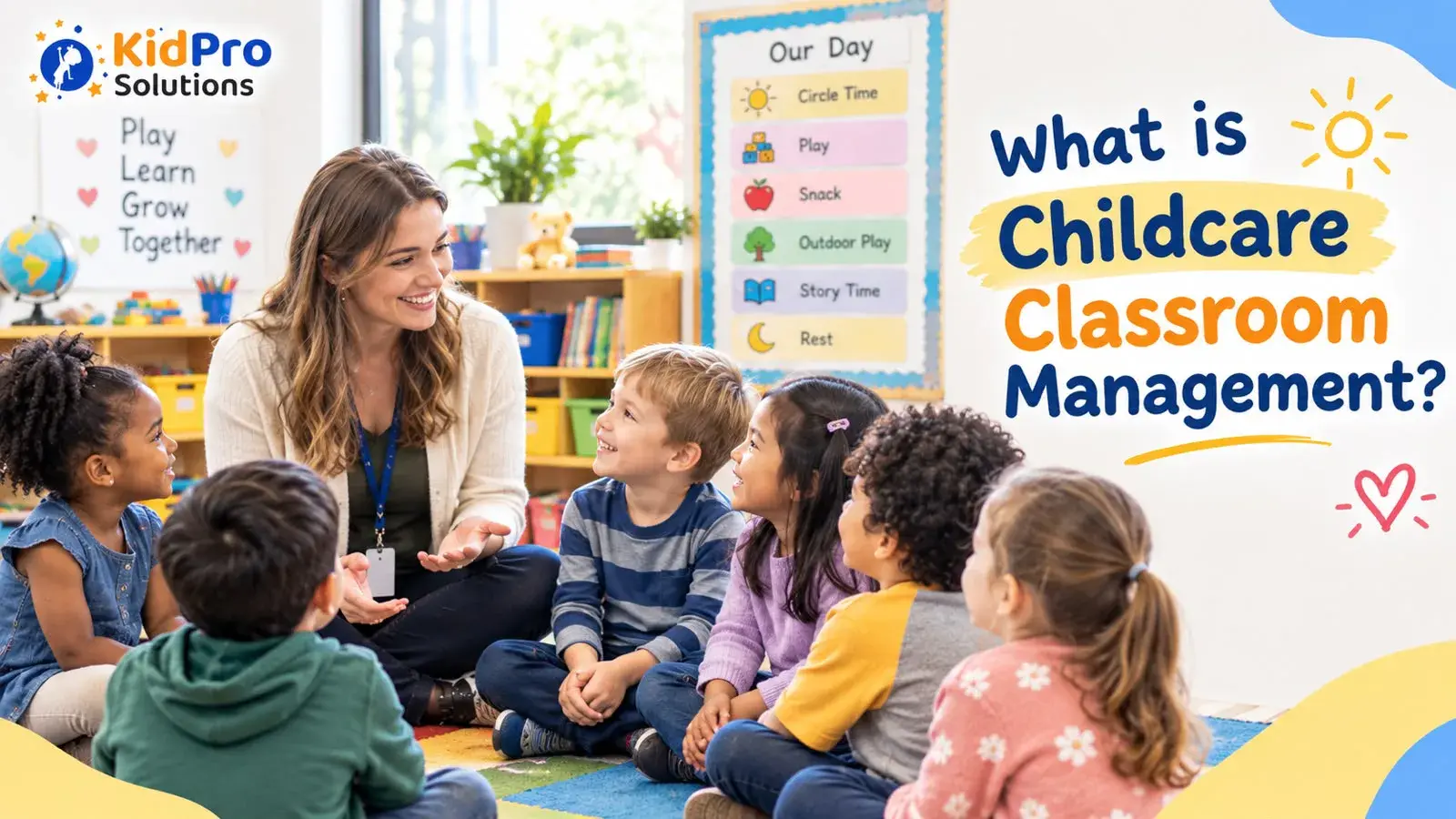
Childcare classroom management is the intentional planning and day-to-day organization of a childcare room so children can learn, play, rest, and interact safely. It includes the physical environment, daily schedule, educator practices, expectations, transitions, supervision, and responses to children’s behavior
In simple terms, it answers five practical questions:
1.How is the classroom arranged?
2.What happens during the day and in what order?
3.How do educators teach expectations?
4.How do adults respond when children struggle?
5.How do children and families receive consistent support?
Childcare classroom management is different from traditional school discipline. Young children are still developing language, impulse control, emotional regulation, and social skills. A toddler who grabs a toy may not yet know how to ask for a turn. A preschooler who shouts during group time may be tired, overstimulated, or unsure how to join the activity.
For that reason, effective management focuses on teaching and guidance rather than punishment. The educator looks at what happened, considers the child’s developmental stage and needs, and helps the child practice a safer or more appropriate response.
Good management also protects time for meaningful learning. When routines are unclear or the environment is difficult to navigate, educators spend more time solving preventable problems. When the space and schedule are thoughtfully planned, staff can spend more time talking with children, extending their play, and observing development.
Why Is Childcare Classroom Management Important?
Childcare classroom management is important because it creates a predictable, responsive environment that helps children feel safe, build relationships, and develop self-regulation . It supports both children and educators by reducing confusion and making the day more manageable.
It creates emotional security
Young children rely on familiar routines and responsive adults. Knowing where belongings go, what happens after outdoor play, and who will help during a difficult moment gives children a sense of security. Predictability does not mean every minute must be rigid; it means children can understand the basic rhythm of the day.
It supports learning through play
Children learn best when they can become deeply involved in play without constant interruptions. A carefully arranged room gives children access to books, creative materials, construction toys, dramatic-play resources, and sensory experiences. Clear boundaries help them use these areas safely and return materials when they are finished.
It develops social and emotional skills
Children need repeated opportunities to practice waiting, negotiating, expressing feelings, solving problems, and repairing relationships. Educators can use everyday moments—such as a disagreement over a truck or a child feeling left out—to teach these skills in context.
It improves supervision and safety
A classroom that is organised for visibility helps educators notice hazards, interactions, and emerging needs. Safe movement paths, age-appropriate materials, and clear activity zones make it easier to supervise without unnecessarily restricting children’s exploration.
It supports educator well-being
Poorly planned routines can lead to constant rushing, repeated instructions, and avoidable conflict. Effective classroom management does not remove every challenging moment, but it gives educators a shared plan for responding. Consistency across the team reduces stress and helps children receive clearer guidance.
It strengthens family partnerships
Families are more likely to feel confident when they receive clear, respectful information about their child’s day. Digital attendance, daily reports, and two-way communication can support this process. KidPro’s childcare management software is designed to bring attendance, daily updates, communication, and other childcare operations into one platform, helping educators and families stay connected.
Common Childcare Classroom Management Challenges
Every group of children is different. A strategy that works well in one room may need to be adjusted for another group, age range, culture, or staffing pattern. Still, several challenges appear regularly in early childhood settings.
Challenging transitions
Moving from free play to mealtime, from indoors to outdoors, or from the playground to rest time can be difficult. Children may be deeply involved in an activity and feel frustrated when it ends. They may also be tired, hungry, or unsure of what is expected next.
Conflicts over toys and space
Children often want the same popular materials at the same time. Limited language, developing turn-taking skills, and strong emotions can quickly lead to grabbing, shouting, or pushing.
Short attention spans during group activities
Long group sessions, unclear instructions, or activities that are not suited to the children’s developmental stage can lead to wandering and disruption. Young children often learn more effectively through short, active experiences than through extended periods of sitting still.
Biting, hitting, and other unsafe behavior
Aggressive behavior can be upsetting for everyone involved. It is important to respond immediately to protect children, while also avoiding shame or labels. The behavior may be connected to communication difficulties, sensory needs, frustration, fatigue, changes in routine, or patterns in the environment.
Different needs in the same room
A mixed-age group may include children who are at very different stages of language, movement, independence, and self-regulation. One schedule or expectation may not work equally well for every child.
Inconsistent responses among educators
If one educator allows running indoors while another immediately gives a consequence, children receive mixed messages. Inconsistency can also cause families to receive different explanations about the same behavior. Team alignment is essential.
Limited communication with families
When families do not know what happened during the day, small concerns can become larger misunderstandings. Communication should be timely, factual, and respectful, especially when discussing behavior or incidents.
10 Practical Childcare Classroom Management Strategies
The most effective strategies are preventative. They make the right behavior easier, teach expectations clearly, and respond to children’s needs before problems escalate.
1. Build predictable daily routines
Create a consistent rhythm for arrival, play, meals, toileting, rest, outdoor time, and departure. The exact clock time may change, but the sequence should be familiar. Use simple visual cues such as photographs, drawings, symbols, or objects that represent the next activity.
Explain changes before they happen. For example, say, “In five minutes, we will pack away the blocks and go outside.” Give another reminder when the transition is close. Young children respond better to preparation than to sudden commands.
2. Teach expectations instead of assuming them
Children do not automatically know what “be good” means. State expectations in clear, observable language: “Walking feet inside,” “Hands are for helping,” or “We put the paintbrushes in the tray.” Demonstrate the behavior and invite children to practice it.
Keep the number of expectations manageable. Three to five positively worded rules are usually easier to remember than a long list of prohibitions. Revisit them through stories, role-play, songs, and daily conversations.
3. Arrange the room with purpose
Set up defined areas for quiet play, active play, messy activities, books, construction, and dramatic play. Place frequently used materials where children can reach them safely. Label shelves with words, pictures, or both so children can participate in tidying.
Observe how children move through the room. If a crowded area causes repeated arguments, add space, duplicate a popular material, or change the layout. Classroom arrangement is not decoration; it is a behavior-support tool.
4. Offer meaningful choices
Limited choices can increase cooperation and independence. Ask, “Would you like to wash hands now or after you put the puzzle away?” or “Would you like to use the blue paper or the yellow paper?” Avoid offering choices when there is no real choice.
Choices should be appropriate to the child’s age and the situation. Two clear options are often enough. Too many options can create more confusion rather than more independence.
5. Use positive, specific feedback
General praise such as “Good job” is pleasant but not always informative. Specific feedback tells children what they did successfully: “You waited for Maya to finish,” “You carried the water carefully,” or “You noticed the book was missing and put it back on the shelf.”
This does not mean praising every action. It means noticing useful behaviors and showing children how those behaviors help the group.
6. Stay close and observe carefully
Active supervision involves more than being in the same room. Move through the space, scan all areas, listen to children’s conversations, and position yourself where you can respond quickly. Observation also helps educators identify patterns.
Ask questions such as:
•What happened just before the behavior ?
•Which activity, time, or location is involved?
•Is the child trying to communicate something?
•Does the child need more support, space, movement, rest, or connection?
•What happens immediately after the behavior ?
This kind of ABC observation—looking at the antecedent, behavior, and consequence—can
help the team plan a more useful response.
7. Make transitions active and engaging
Use songs, movement, simple jobs, picture cues, or a transition object to help children move between activities. Give children a role: one child can carry the attendance clipboard, another can check whether the books are on the shelf, and another can lead a familiar song.
Avoid waiting with a large group while one task takes place. Stagger handwashing, offer a small waiting activity, or prepare materials in advance so children remain engaged.
8. Teach emotional regulation in calm moments
Children cannot learn a calming strategy for the first time when they are already overwhelmed. practice breathing, asking for help, using a quiet space, naming feelings, and getting a drink of water during ordinary parts of the day.
A calm corner should not be used as a punishment area. It can include soft furnishings, emotion cards, sensory materials, books, or visual prompts. An adult may need to accompany a child until the child is ready to rejoin the group.
9. Respond to unsafe behavior calmly and immediately
First, protect the children involved. Use a calm voice and brief language: “I will not let you hit. Hitting hurts.” Attend to the child who was hurt, then support the other child to calm down and communicate what happened.
Once everyone is regulated, help the children repair the situation. Depending on their age, this may involve checking on a friend, getting an ice pack, returning a toy, practising words, or making a plan for the next turn. Avoid forcing an apology that the child does not understand.
10. Work as a consistent team
Agree on key routines, safety expectations, language, incident procedures, and communication practices. Review what is working during staff meetings and adjust strategies based on observations rather than assumptions.
Consistency does not mean every educator must use exactly the same words. It means the underlying expectations and principles are shared: children are treated with respect, unsafe behavior is addressed, and guidance is appropriate to development.
A Step-by-Step Plan for Improving Classroom Management
If a room feels unsettled, trying to change everything at once can overwhelm the team. Use a simple improvement cycle instead.
Step 1: Identify one priority
Choose the issue that has the greatest effect on safety, learning, or staff well-being. It might be arrival time, transitions, toy conflicts, or rest time.
Step 2: Observe before changing the plan
Record what happens for several days. Note the time, location, people involved, activity, possible trigger, and how adults respond. Keep notes factual and avoid labels such as “naughty” or “attention-seeking.”
Step 3: Make one environmental adjustment
Change the layout, schedule, materials, group size, or visual cue connected to the problem. For example, add duplicate popular toys or divide a large transition into smaller groups.
Step 4: Teach the replacement skill
If children are grabbing, teach how to ask for a turn. If they are running during transitions, practice walking with a game. If they are shouting to get help, model a phrase or visual signal they can use instead.
Step 5: Use the plan consistently
Give the strategy enough time to become familiar. Ensure every educator understands the purpose and the agreed response.
Step 6: Review the result
Ask whether the behavior has changed, whether children are more engaged, and whether educators feel the routine is easier. Keep what works, refine what does not, and choose the next priority only after the first improvement is established.
Supporting Different Age Groups
Infants
For infants, management is mainly about responsive care, safe spaces, predictable caregiving, and reading cues. Use calm voices, consistent routines, and flexible timing for sleep, feeding, and comfort. Avoid expecting infants to follow group rules they are not developmentally ready to understand.
Toddlers
Toddlers benefit from short instructions, visual cues, repetition, movement, and immediate support. Offer simple choices and name feelings without expecting long explanations. Keep transitions brief and provide safe opportunities to climb, carry, push, pour, and explore.
Preschool children
Preschoolers can participate more actively in planning, problem-solving, and classroom responsibilities. Invite them to help create group agreements, discuss possible solutions to conflicts, and reflect on what helps everyone learn. Keep expectations clear while allowing room for imagination and independence.
Common Childcare Classroom Management Mistakes to Avoid
Relying on punishment instead of teaching
Punishment may stop a behavior temporarily without teaching the skill the child needs. Focus on prevention, instruction, connection, and repair.
Giving directions that are too vague
“Be nice” or “Settle down” does not tell a child what to do. Use short, positive, specific instructions and check that the child understands.
Expecting children to wait too long
Long waits create boredom and conflict. Prepare materials, stagger routines, and keep group experiences developmentally appropriate.
Using public shame or labels
Calling a child “naughty,” “difficult,” or “a bully” can damage trust and does not explain the behavior . Describe what happened and focus on the next safe action.
Ignoring the environment
If the room is crowded, noisy, poorly stocked, or difficult to navigate, behavior plans alone will not solve the problem. Review the physical setup as carefully as the child’s actions.
Changing strategies too quickly
Children need repetition and adults need time to evaluate whether a change is helping. Make adjustments thoughtfully rather than moving from one reaction to another.
Keeping families out of the conversation
Families hold valuable information about a child’s routines, communication, culture, and recent changes. Share observations respectfully and invite collaboration rather than presenting a problem as the family’s fault.
Recording information inconsistently
Important information can be missed when attendance, incidents, daily activities, and family messages are kept in separate places. A central system for digital attendance and daily reports can make routine communication more organised, while educators remain responsible for using professional judgment and protecting privacy.
How Technology Can Support Classroom Management
Technology cannot replace attentive educators, thoughtful room design, or relationships with children. It can, however, reduce administrative friction that takes educators away from the classroom.
Useful childcare technology may support:
•Digital check-in and check-out
•Attendance and arrival records
•Health and safety information
•Daily activity updates
•Parent messaging
•Staff and room information
•Reports for center administration
When routine records are easier to complete, educators and directors have more time to focus on children. Choose tools that are simple enough for daily use, protect sensitive information, and fit the center’s actual workflow. A platform such as KidPro can support parent communication and childcare operations alongside classroom practice.
Conclusion: Build a Classroom Where Children Can Succeed
Effective childcare classroom management is built through thoughtful environments, predictable routines, respectful relationships, active supervision, and patient teaching. When a child struggles, the most useful question is often not “How do we stop this behavior ?” but “What skill, support, or environmental change would help this child succeed?”
Start with one daily challenge. Observe it carefully, make a practical adjustment, teach the expected skill, and review the result with your team. Over time, these small improvements can create a calmer classroom without taking away the energy, creativity, and play that make early childhood education meaningful.
Strong classroom practice also depends on strong communication beyond the room. If your center needs a simpler way to manage attendance, daily updates, and family communication, explore KidPro’s childcare management platform and consider how digital tools could give your team more time to focus on children.
The main goal is to create a safe, predictable, inclusive environment where children can participate, build relationships, and develop independence. It is not simply to keep children quiet or eliminate all challenging behavior.
A useful framework includes the physical environment, daily routines, relationships and interactions, and behavior guidance. Effective management considers all four rather than relying on rules alone.
First identify why the room is noisy. Children may need more movement, smaller groups, clearer instructions, or better-defined activity areas. Use visual and verbal cues, reduce unnecessary waiting, and teach an appropriate voice level for each activity.
Protect the children, use calm and brief language, attend to the child who was hurt, and help the other child regulate. Then investigate possible triggers and teach a replacement skill, such as using words, asking for help, or moving to a different space. Follow the center’s safeguarding and incident-reporting procedures.
Use multiple ways for children to communicate and participate, adapt the environment, consider sensory needs, provide visual support, and avoid assuming that the same expectation or strategy will work for every child. Collaborate with families and relevant professionals when appropriate.
Families can use similar language for routines, practice turn-taking and emotional vocabulary, share relevant changes with educators, and ask about strategies that work in the center. Consistency helps, but home and childcare settings do not need to be identical.

KidPro simplifies enrollment, attendance, parent communication, billing, and daily reporting with one easy-to-use childcare management platform.
Explore
Copyright ©2026 KidPro


